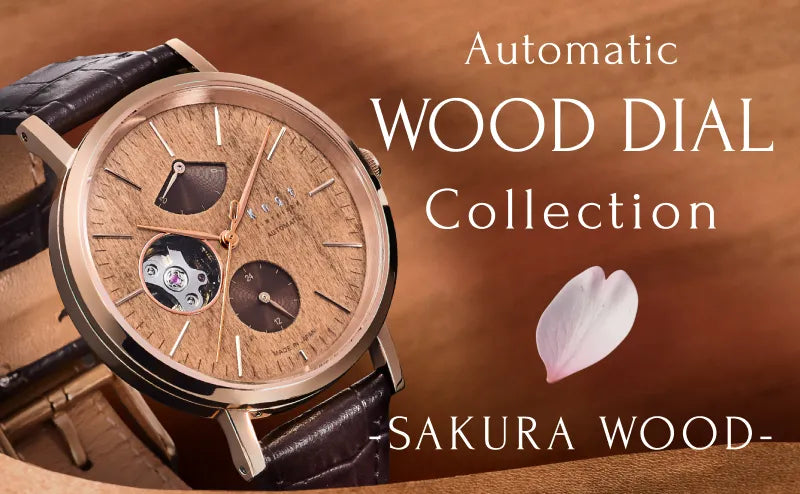
The WOOD DIAL Collection features dials made from natural cherry wood. At the heart of this collection – bringing the warmth of natural materials to the “face” of a wristwatch, where metal and resin are the norm – is “sewable wood”, a material developed by Taniguchi Co. Ltd.

This original material consists of natural wood shaved to a thickness of just 0.1mm, bonded with a backing layer. Despite being genuine wood, it can be bent and even stitched. Beyond applications such as bags and small goods, it holds potential for use in clothing, wallpaper, curtains, and a wide range of other fields.
The development of this material took approximately 12 years. What ideas sparked its creation, and what trial and error shaped it along the way? We spoke with Masaharu Taniguchi, President of the company and the developer of “sewable wood”
An Idea Born from Wood Shavings

“When you plane wood in the workshop, thin shavings curl off, don’t they? Watching them, I began to wonder if they could be used for something.”
The thin shavings produced during planing are typically discarded as by-products of the manufacturing process. Yet Taniguchi felt that even these “scraps” retained the warmth and character unique to natural wood. Alongside a desire to make full use of natural resources and the practical considerations of running a business, a persistent spirit of inquiry – “could this be used for something?” – continued to occupy his thoughts.
“When I brought it up internally, most people said, ‘President, that’s impossible’. They couldn’t imagine something like that becoming a product (laughs). Still, I thought that perhaps it could work in applications where light passes through, so I first tried making a lampshade. If thin wood is arranged flat, light can pass through it. I felt that might hold some potential.”

This initial lampshade prototype led Taniguchi and his team to begin refining wood into sheet materials. If thin wood could be bent or folded, it could be applied not only in furniture and interiors, but also across fields such as fashion and everyday goods. However, achieving this presented significant technical challenges.
In conventional veneer applications, where wood is applied as a decorative surface layer, around 0.2–0.3mm is typically the minimum thickness required. At that thickness, however, the material cracks easily when bent. Making it even thinner was essential – but at the time, no machine existed that could achieve this.
“I asked machinery manufacturers, ‘Can you build a machine that can shave wood even thinner?’ but the answer was always no. Still, a hand plane produces shavings of around 0.1mm. So I believed it should be possible with a machine as well, and I refused to give up.”
By modifying existing woodworking machinery and carefully adjusting blade angles, pressure, and feed speed, the team continued to refine their prototypes. They strengthened the blades through heat treatment and fine-tuned processing conditions to prevent tearing. Through these steady improvements, they ultimately established a method for consistently producing wood sheets as thin as 0.08mm.

“But that wasn’t the end of it. When you sew with a machine, it creates holes, and from those holes, the material would tear. So we bonded backing materials such as non-woven fabric or linen with adhesive. The choice of materials and their balance were critical – if the adhesive hardened too much, the wood would crack when bent. Working together with adhesive manufacturers, we developed a solution that met safety standards, and that’s how ‘sewable wood’ – material that can be stitched with a sewing machine – was realized.”

The WOOD DIAL Collection, Where the Essence of Sakura is Brought to Life

This “sewable wood” is what made the WOOD DIAL Collection by Knot possible.
The dial uses natural cherry wood, just 0.12mm thick, with a backing layer of similar thickness applied to it. Compared not only to conventional wooden dials but also to those made of metal or resin, it is exceptionally thin, allowing for slimmer cases and a greater sense of depth in design.

“In the case of cherry wood, around 0.12mm is the most stable thickness. It also tends to show a relatively uniform grain, which helps ensure legibility as a watch while still allowing you to appreciate the character of natural wood. Cherry is a popular material both in Japan and abroad, and it has a naturally sweet fragrance as well. Unfortunately, you won’t be able to smell it in the finished watch (laughs), but I believe it appeals to the senses in many ways.”

Of course, the soft pink hues and the natural variation unique to wood are also part of its appeal.
“It contrasts beautifully with a silver case, and pairs very well with rose gold too. I actually wear this watch every day myself, and I show it off to everyone I meet (laughs).”
Creating What Can Only Be Achieved Here

Taniguchi Co. Ltd. was founded in 1947. Originally known as a woodworking manufacturer specializing in goke – bowls used to hold stone counters in the game of Go – the company once held a significant share of the market during a time when Go culture was widely popular. However, as times have changed, the market has gradually contracted, and the number of such manufacturers (once around 80 nationwide) has dwindled to just a handful.
Taniguchi, a member of the company’s second generation, studied mechanical engineering at university, worked at a machinery manufacturer, and later joined the family business. By modifying woodworking machinery himself and rethinking production processes, he expanded the company into new product fields.

“In many woodworking companies, there’s a division of labor where materials are sourced and then processed separately. But we handle everything in-house – from purchasing logs to sawing, processing, and finishing. That allows us to prototype very quickly. Outsourcing can take six months to a year, but in-house we can test ideas immediately. That became a major strength in developing new materials.”
Today, the company has 12 employees. It is by no means large, but Taniguchi believes that this scale enables a particular kind of craftsmanship.
“What we aim for is to create things that can only be achieved here. In the woodworking industry, it’s difficult to compete globally through mass production. Even if we remain small, we want to be a company with technologies that cannot be found anywhere else in the world.”

This philosophy is also reflected in their daily work. When customers approach them with requests – “Could you make something like this?” – they never dismiss them outright, but instead consider how it might be achieved.
“We’ve been asked things like whether wooden exteriors for mobile phones are possible, or whether it could be used in car interiors. Even when something seems extremely difficult, we think about how it could be done and try it. Of course, there are many failures. But those failures lead to the next technology.”
Wood products have long been an integral part of everyday life in Japan, used in homes, furniture, tools, and more. Even today, as artificial materials such as metal and plastic become more prevalent, Taniguchi believes the appeal of wood remains unchanged.
“Wood is something you can appreciate visually and enjoy through touch. Even having a single wooden element in a room somehow creates a sense of calm. It’s a natural material, and each piece has its own unique expression. That’s why people find it comforting.”
Co-Creation in Japanese Craftsmanship
Taniguchi also expresses concern about the current state of traditional crafts in Japan. While issues such as market contraction and a shortage of successors are often discussed, he believes there is another underlying challenge.

“Many areas of traditional craft are now in decline. There are various reasons, but I feel that clinging to past success is also part of the problem. What must not change is the craftsmanship itself – the techniques passed down over time. There are traditions that must be preserved. However, design and application must evolve with the times. Otherwise, those valuable techniques will no longer be used. ‘Sewable wood’, which began from something as simple as wood shavings, was born from that very mindset.”
In this sense, he believes collaboration between companies in different fields is essential.
“It’s difficult for a single company to create something entirely new on its own. By combining technologies from different fields, one plus one can become three. I believe our collaboration with Knot is one such example.”
The WOOD DIAL Collection is also a product born from this kind of co-creation – bringing together the technologies of woodworking and watchmaking to create new value.

“To be honest, I never imagined wood could become a watch dial. But when someone asks, ‘Could you make something like this?’ it opens up new possibilities. Those encounters are essential to craftsmanship.”
The WOOD DIAL Collection, imbued with the warmth of cherry wood. Within its dial reside twelve years of trial and error, and the spirit of inquiry of artisans deeply versed in its nature.
WOOD DIAL Collection ーSAKURA WOOD